
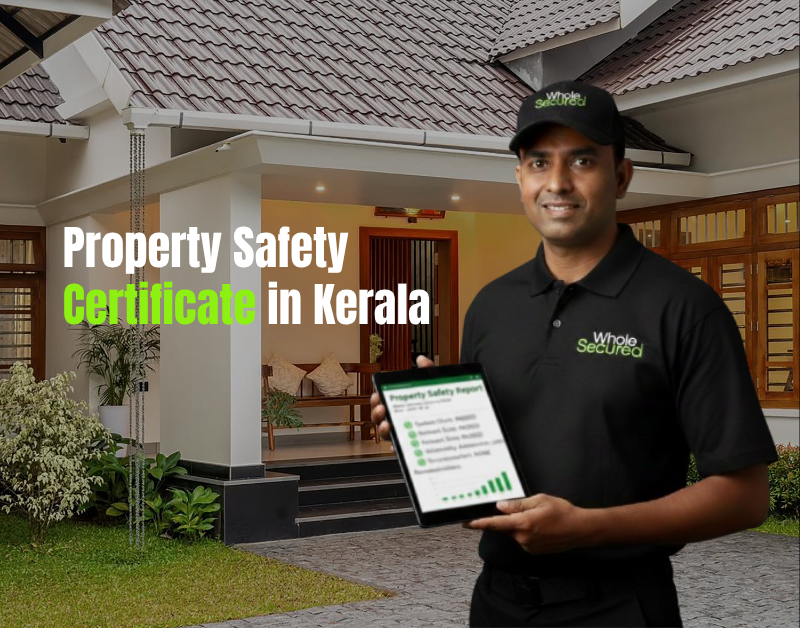
Property Safety Certificate in Kerala — What It Is, Why You Need One, and How to Get It
Property Safety Certificate in Kerala — What It Is, Why You Need One, and How to Get It Most property owners in Kerala have heard of a completion certificate, an occupancy certificate, or a building permit. But very few have heard of a property safety certificate — and that gap is exactly where serious accidents happen. A property safety certificate is not a legal formality. It is a verified confirmation, issued after a professional inspection, that the critical infrastructure of your property — electrical systems, plumbing, civil structure, drainage, fire safety, HVAC, and more — meets the required safety standards for safe occupation and use. In Kerala, WholeSecured is currently the only organisation issuing structured property safety certificates backed by an independent, multi-system inspection process. This guide explains exactly what a property safety certificate is, why it matters, who needs it, and how the certification process works. What Is a Property Safety Certificate? A property safety certificate is a formal document issued to a property after it has been professionally inspected and verified to meet defined safety standards. It confirms that the property’s infrastructure is safe, functional, and fit for occupancy or use at the time of inspection. It is important to understand what a property safety certificate is not. It is not a government-issued permit. It is not an automatic entitlement. It is not a cosmetic assessment. It is a professional, evidence-backed verification document that gives property owners, buyers, tenants, and institutions clarity on the actual safety condition of a building. Think of it like a health certificate for your building — the same way you would want a doctor’s clearance before trusting your health, a property safety certificate gives you professional clearance before trusting your building. Why Kerala Properties Specifically Need This Kerala’s climate and construction patterns create risks that are not as common in other Indian states. High humidity accelerates electrical insulation breakdown. Heavy monsoon seasons cause water ingress into walls, foundations, and concealed cable conduits. Coastal properties face salt-induced corrosion of structural reinforcement and electrical components. On top of climate factors, a significant portion of Kerala’s residential and commercial buildings were constructed between the 1980s and early 2000s — a period when safety standards were inconsistently applied and electrical load capacity was designed for a fraction of today’s appliance usage. The result is a property stock where serious hidden risks — overloaded wiring, concealed leaks, weakened structural elements, non-functional fire safety systems — are common, and often invisible to the naked eye during a standard property visit. A safety certificate brings these risks to the surface through professional inspection before they become accidents. Who Needs a Property Safety Certificate in Kerala? A property safety certificate is relevant across nearly every category of property ownership and transaction in Kerala. Here is where it provides the most direct value: Property Owners If you own a home, apartment, villa, or commercial space in Kerala, a safety certificate gives you documented confirmation of your building’s current safety condition. It also creates a baseline record for ongoing maintenance and serves as protection if a safety-related dispute or insurance matter arises. Property Buyers Before investing in any property — whether a flat in Kochi, a villa in Thrissur, or a commercial space in Kozhikode — a safety certificate confirms that the building you are purchasing is genuinely safe, not just visually presentable. It removes the risk of discovering expensive hidden defects after ownership has transferred. Tenants and Occupants Tenants have a right to know whether the building they are moving into meets basic safety standards. A safety certificate provides that assurance in writing, backed by professional inspection rather than the landlord’s word. Building Developers and Promoters For developers, a WholeSecured safety certificate signals to buyers that the building has been independently verified — not just completed and handed over. In a market where buyer trust is increasingly important, certification is a meaningful differentiator. Commercial and Industrial Operators Offices, retail spaces, manufacturing units, and warehouses that hold a current property safety certificate demonstrate a commitment to occupant safety and infrastructure reliability — relevant for staff, clients, insurers, and regulators alike. What Systems Are Evaluated During the Certification Inspection? WholeSecured’s certification inspection covers eight critical building infrastructure systems. Each system is evaluated for safety, functionality, and condition as part of a structured, documented assessment. Electrical systems — wiring integrity, load capacity, panel condition, earthing, and fire risk factors Plumbing systems — pipeline condition, pressure, leakage detection, and water supply reliability Civil structure — foundation stability, wall and beam condition, dampness, waterproofing, and structural load safety Fire and emergency safety — extinguishers, alarm systems, emergency exits, and evacuation pathways HVAC systems — ventilation efficiency, air conditioning performance, and indoor air quality Drainage systems — outflow performance, blockage assessment, and waterlogging risk Water Treatment Plant (WTP) — filtration condition, storage tank hygiene, and water quality Sewage Treatment Plant (STP) — treatment tank condition, pump performance, and discharge quality After the inspection, a detailed Safety Inspection Report is prepared. This report documents the findings for every system, assigns a risk status to identified issues, and provides specific corrective recommendations where required. How the Certification Process Works WholeSecured’s property safety certification follows a structured, four-stage process. Certification is never issued automatically — it is earned through verified inspection. Stage 1 — Property Safety Inspection A WholeSecured inspector conducts a professional on-site evaluation of the property across all eight critical systems. The inspection is systematic, documented, and carried out using standardised assessment protocols. Stage 2 — Safety Inspection Report Following the inspection, a comprehensive report is prepared. This document covers the condition of every system inspected, identifies specific safety risks or infrastructure issues, and includes photographs and recommendations. The report is provided to the property owner in full. Stage 3 — Safety Verification WholeSecured’s team reviews the inspection findings to determine whether the property meets the required safety standards for certification. This is a critical step — not every inspection automatically leads to certification. Stage 4 —
