
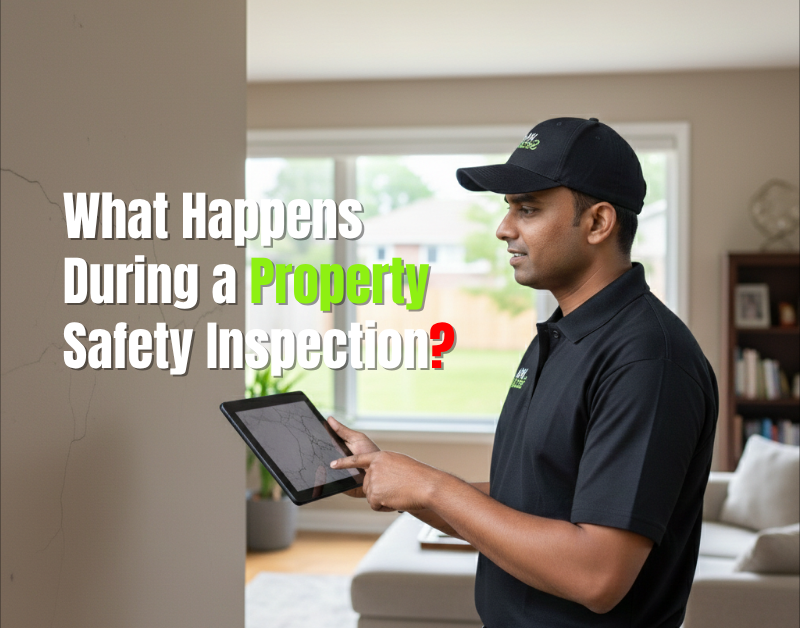
What Happens During a Property Safety Inspection? A Complete Step-by-Step Walkthrough
What Happens During a Property Safety Inspection? A Complete Step-by-Step Walkthrough If you have never had a professional property safety inspection done, you might wonder what exactly happens — who comes, what they look at, how long it takes, and what you receive at the end. It is a fair question, and a clear answer makes the process less unfamiliar and easier to commit to. This guide walks you through a WholeSecured property safety inspection from start to finish — exactly what happens at each stage, what systems are assessed, what the inspector is looking for, and what the final report tells you. Whether you are a homeowner, a property buyer, or a building manager, understanding the process makes the value of inspection immediately clear. Before the Inspection — Booking and Preparation The process begins when you contact WholeSecured to schedule an inspection. At this stage, the WholeSecured team will ask you some basic questions about the property: its type (home, apartment, commercial building, industrial unit, warehouse), its approximate size and age, the city or area, and what has prompted the inspection — whether it is a routine safety check, a pre-purchase assessment, a requirement before enrolling in the Preventive Maintenance Plan, or something else. This initial conversation helps WholeSecured allocate the right inspector with the relevant expertise and estimate the time required for the site visit. A standard residential inspection for a mid-sized home or apartment typically takes between three and five hours. Larger or more complex commercial or industrial properties may take longer. You will be asked to ensure access to all areas of the property — including electrical distribution boards, water tanks, drainage access points, and any utility plant rooms — before the inspector arrives. If drawings or previous inspection reports are available, sharing them in advance is useful context, though not mandatory. Stage 1 — Site Arrival and Initial Walkthrough When the WholeSecured inspector arrives at the property, the first step is an initial walkthrough — a broad visual orientation that gives the inspector an understanding of the building’s layout, age, construction type, and condition before the detailed system-by-system assessment begins. During this walkthrough, the inspector is noting the overall impression of the property: the construction quality visible in finishes, the condition of walls and ceilings, any immediately visible signs of seepage or dampness, the general state of electrical fixtures and plumbing fittings, and the access arrangements for the systems that will need to be assessed in detail. The property owner or a representative is usually present during this stage. The inspector may ask questions about the history of the property — any known past issues, previous repairs, the age of electrical wiring, whether any renovation work has been done. This information contextualises the technical findings. Stage 2 — Electrical System Inspection The electrical inspection is typically the most technically detailed part of the assessment. The inspector begins at the main distribution board — examining the type and condition of MCB and RCCB devices, checking for correct labelling, assessing whether the board shows signs of overheating, looking for loose connections, and verifying that the board is housed in a fire-resistant enclosure. From the distribution board, the inspection works through the property’s wiring system. The inspector checks the type of wiring used — modern PVC-insulated copper wiring is standard, but older properties may have aluminium wiring or pre-1990s rubber-insulated cables, both of which carry higher risk. Visible wiring is inspected for damage, improper jointing, inadequate protection in high-risk areas, and overloading indicators. The earthing system is assessed separately. Earthing is one of the most frequently deficient aspects of electrical safety in Kerala homes — a missing or poorly implemented earth creates severe electrocution risk that is completely invisible under normal use. Socket outlets and switch points are inspected for burn marks, sparking signs, or damage. The inspector also assesses whether the overall load distribution across circuits is appropriate for the property’s current usage — a common issue in homes where multiple air conditioning units and high-load appliances have been added over time without a corresponding upgrade to the electrical system. Stage 3 — Plumbing and Water System Inspection The plumbing inspection covers the full water supply and distribution network within the property — incoming supply connection, overhead tank condition, pipe materials and condition, water pressure, and the condition of all sanitary fittings and outlets. The inspector checks for visible and concealed leaks. Concealed plumbing leaks are particularly common in Kerala buildings — moisture seeping through bathroom and kitchen walls, dampness in walls adjacent to concealed pipes, and discolouration on ceilings beneath upper-floor bathrooms are all investigated. Thermal imaging or moisture detection tools may be used where access to concealed pipework is not practical. Pipe material is assessed as part of this stage. GI (galvanised iron) pipes, common in apartments built before 2005, are prone to internal corrosion over time, which reduces water pressure, introduces contamination risk, and eventually leads to pipe failure. Identifying this early helps owners plan for replacement before a more costly emergency situation arises. Stage 4 — Civil Structure and Building Condition The structural assessment examines the physical fabric of the building — walls, floors, ceilings, roof, foundation, and the primary structural frame. Cracks are one of the most common findings in Kerala’s residential properties. The inspector classifies any cracks identified by type: hairline shrinkage cracks are cosmetic, while cracks with specific patterns — stair-step cracks in brickwork, diagonal cracks from door and window corners, or cracks with visible displacement — may indicate structural movement that requires further investigation. Dampness and seepage are examined systematically. Kerala’s climate means that dampness from rising moisture, terrace seepage, or concealed plumbing is extremely common. The inspector identifies the source, the extent, and the likely repair path. Waterproofing condition is assessed for terraces, external walls, wet areas, and any basements or underground areas. Failed waterproofing is one of the most frequent causes of structural deterioration in Kerala buildings over time. Stage 5 — Fire and Emergency Safety